Phonics
No items found.




At Lift North Thoresby we use a phonics programme called Read, Write, Inc (RWI). This page aims to provide all the necessary information about RWI phonics, including how we teach your children phonics at school and how you are able to support your child at home.
Please look out for the useful video links at the bottom of the page for more information and, importantly, to show how to pronounce the individual letter sounds.
Phonics is a method of teaching children to read. Phonics works by breaking words down into its individual sounds. There are 44 different sounds in the English language. Learning to read with phonics is therefore a bit like learning a code, and after learning just a few sounds, you will be able to use this code to read hundreds of words. The more sounds you know, the more words you will be able to work out how to read. Not all words are phonetically decodable, however, a select few words you need to learn through the 'sight words' method of learning to read.
The Read Write Inc. programme is for primary school children learning to read. It is a phonics based programme which helps children learn to read whilst also developing a wide range of vocabulary and encouraging a love of stories. Read Write Inc. is a government backed phonics scheme designed by Ruth Miskin, which through systematic teaching and consistent routines, enables children to achieve high levels of reading success.It was developed by Ruth Miskin and more information on this can be found at www.ruthmiskinliteracy.com. At North Thoresby, we believe that reading is the key to all learning and we are fully committed to making sure that every child is a reader by the end of KS1.
This link provides some further information: Read, Write, Inc.
In reception, all children will learn how to ‘read’ the sounds in words and how those sounds can be written down.
The children:
The children:
The children:
Children follow the same format as Reception but will work on complex sounds and read books appropriate to their reading level.
Five key principles underpin the teaching in all Read Write Inc. sessions:
Children will be taught how to read as follows:
Before you start to teach your child, practise saying the sounds below. These are the sounds we use to speak in English.
If your child’s school is using Read Write Inc. Phonics, teachers will introduce your child to a toy frog called Fred once he or she is ready to start reading words.
Fred can only say the sounds in a word and needs your child to help him read the word. Fred will say the sounds and children will work out the word. For example, Fred will say the sounds c–a–t, and children will say the word cat. This is Fred Talk: sounding out the word.
The children are taught the sounds in 3 sets.
Set 1 Sounds are taught in the following order together with rhymes to help children form the letters correctly and instantly recognise sounds ready for blending. First, your child will learn to read:
Set 1 Sounds
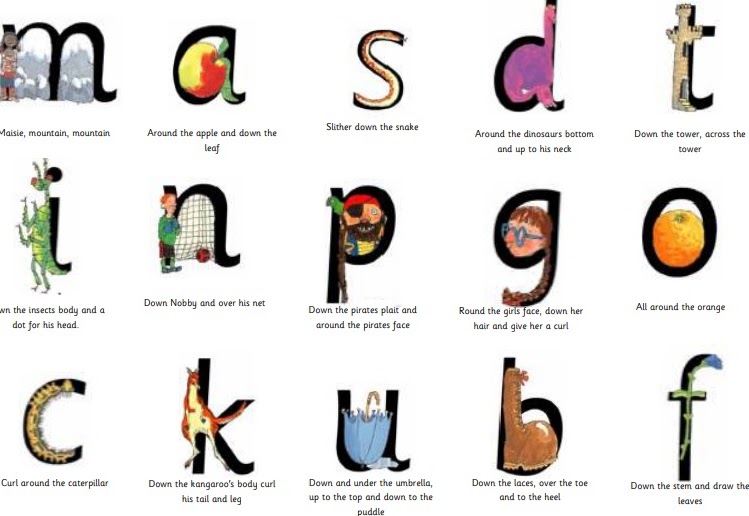
Please do not use letter names at this early stage (reception).
Children will also use pictures above for each sound to help recognise the sound and then form the shape of the sound.
Click the link to find out how to pronounce the sounds correctly: Pronouncing the sounds
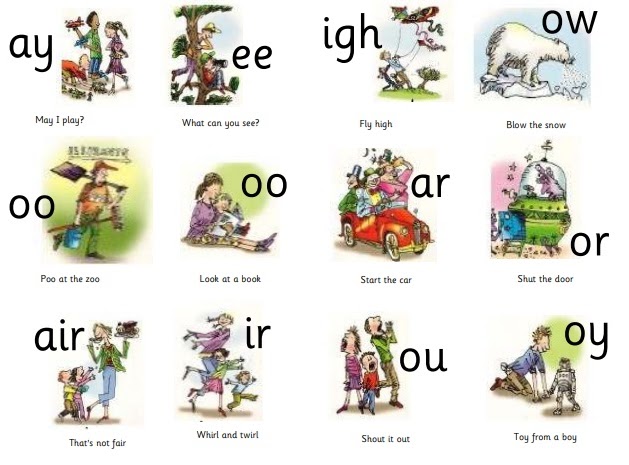
Once your child knows all their single sounds, some simple 'special friends' and has learnt to blend simple words, they will now learn Set 2 Sounds - the long vowels:
ay ee igh ow oo oo ar or air ir ou oy
Set 2 Sounds
When they are very confident and growing in reading ability with all of set 1 and 2 they are taught Set 3 Sounds.
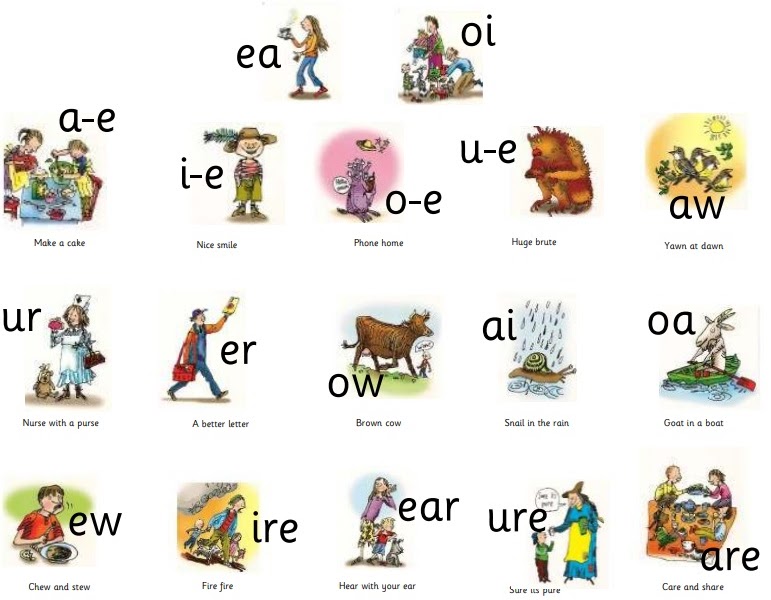
In Set 3, they will learn to:
ea oi a-e i-e o-e u-e aw are ur er ow ai oa ew ire ear ure
Set 3 Sounds
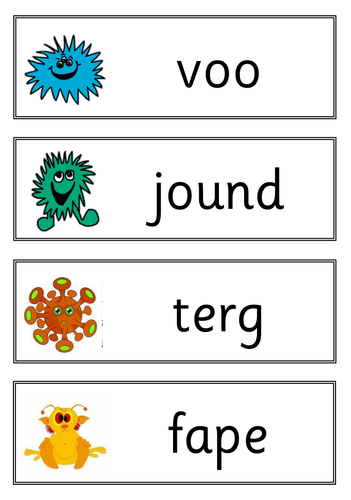
Nonsense words (Alien words)
As well as learning to read and blend real words, children will have opportunities to apply their sound recognition skills on reading ‘Nonsense words’. These words will also feature heavily in the Year One Phonics Screening check in the summer term.
Children will be introduced to ‘Ditty books’ when they successfully begin to read single words.
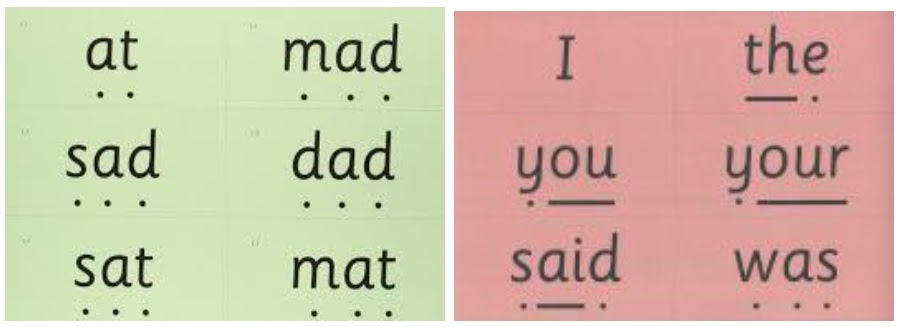
The short vowels should be kept short and sharp:
Dots and dashes represent the sound each letter makes.
Once your child has been introduced and taught these words in school we will send them home for you to continue practising with your child.
During the RWI session children will read the book three times and at each new reading they will have plenty of opportunities to practise using their developing comprehension skills.
Hold a sentence is an activity that encourages children to remember a whole sentence while focusing on spelling and punctuation.
Build a sentence is to give children the opportunity to create their own sentence that shows the meaning of a word and editing a sentence allows the children to critique a sentence using their knowledge of spelling, punctuation and grammar. Children complete a longer piece of independent writing, which gives them the opportunity to show off their creativity and to practise their spelling, grammar and punctuation.
The Phonics Screening Check is a test for children in Year 1. Children take it during June in a one-to-one setting with a teacher. This is usually their class teacher, but it could also be the headteacher or another teacher who knows the child well.
Whilst children learn phonics to help them with both word reading and spelling, the Phonics Screening Check only tests their skills at word reading. This is sometimes called decoding.
During the Phonics Screening Check, children are asked to read (decode) 40 words. Most of these words are real words but some are pseudo-words. Pseudo-words are included to ensure that children are using their decoding skills and not just relying on their memory of words they’ve read before. Because some children may misread these pseudo-words based on their similarity to words in their existing vocabulary, each pseudo-word is clearly identified with an image of an alien. Most teachers and children, therefore, refer to pseudo-words as alien words.
As your child is bringing books home, please make sure that you are reading with your child on a regular basis. We want reading to be a pleasurable and enjoyable experience so please make sure that you give your child lots of praise and encouragement! Please be aware that this is a time of transition for your children and as part of that book bandings may begin to differ and change.
If you have any other questions about RWI, please see your class teacher.
Parent video: Understanding Phonics
Parent Video: Pronouncing the Sounds
Parent video: 10 things to think about when you read to your child
Parent video: Why read to your child?
Parent video: The Phonics Screening Check
Parent video: Reading the stretchy sounds with your child

Lift North Thoresby
High Street,
North Thoresby,
Grimsby,
Lincolnshire,
DN36 5PL